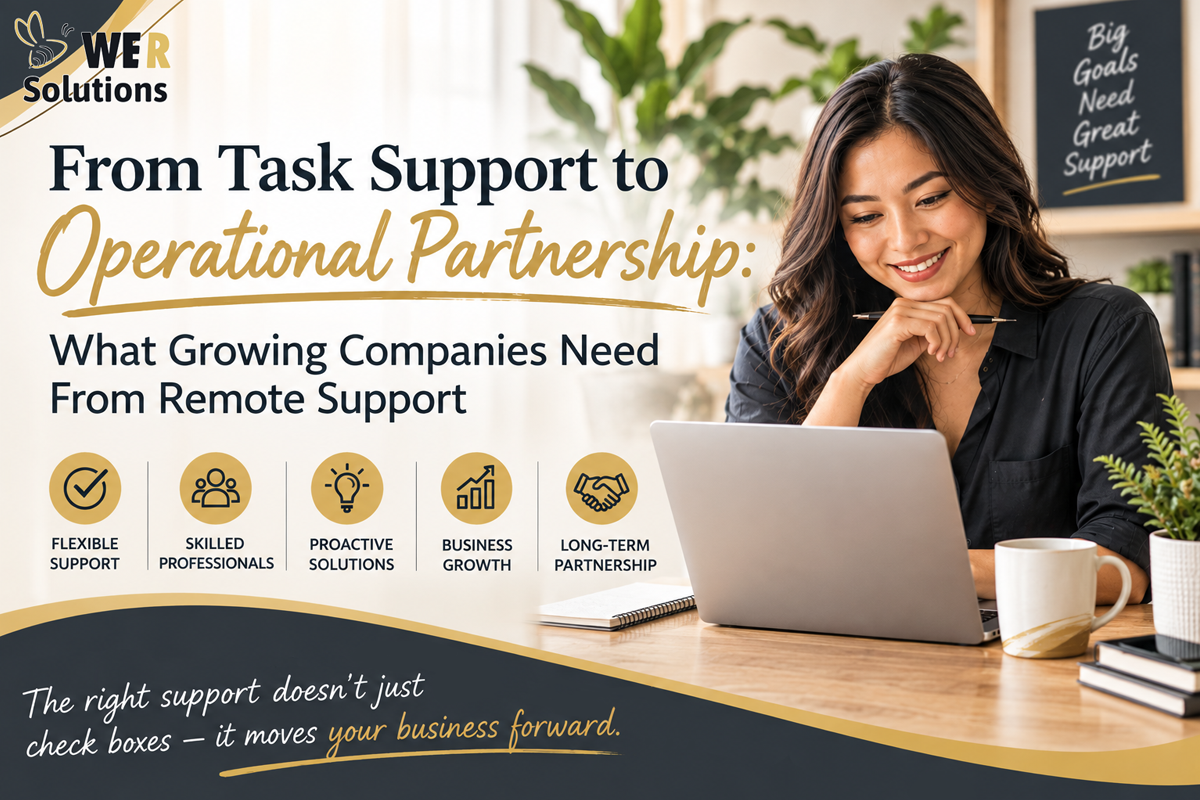
Growth changes what a business needs from its support.
In the early stages, getting a few tasks off your plate can make an immediate difference. Someone manages the inbox, updates the CRM, schedules content, conducts research, follows up with clients, or handles administrative work. The relief is real.
But as a company grows, simply getting tasks completed is no longer enough. There are more clients to serve, more systems to maintain, more people involved in decisions, and more opportunities for something important to fall between the cracks.
At that point, the question changes. It is no longer, “Who can do this task?” It becomes, “Who can own clearly defined responsibilities within this area and help us keep the work moving?”
That is the shift from transactional task support to a real operational partnership.
At WE R Solutions, we have seen that effective delegation involves more than assigning tasks to a capable person. The role needs clear expectations, the right processes, agreed communication practices, and a support structure that helps both the client and the remote professional succeed. Without those elements, outsourcing can leave a business owner managing the same work through another person.
A Partner Understands What the Task Supports
There is nothing inherently wrong with hiring someone for a specific task. Sometimes that is exactly what a business needs: you provide the instructions, the work is completed, and the engagement ends or another request follows.
But growing companies eventually need more than a series of transactions.
Imagine a leader who delegates client follow-ups to a virtual assistant. In a purely task-based relationship, the instruction may be, “Send these follow-up emails.” The emails are sent, so the task is considered complete.
An operational partnership looks further. Which clients need follow-up? When should it happen? Where should the interaction be recorded? Which responses can the virtual assistant handle within agreed boundaries? When should something be escalated? What information does leadership actually need to see?
The task itself may be simple. The responsibility surrounding it is not. Strong remote support understands how individual tasks contribute to client experience, team coordination, and larger business outcomes.
When Delegated Work Still Requires Too Much Leadership
Task outsourcing can create capacity quickly, but it can also create another layer of management. The leader assigns the work, explains the process, answers the questions, checks whether everything was completed, catches what was missed, and then assigns the next round.
Technically, the work has been delegated. Operationally, responsibility still sits with the leader. This is why some business owners say, “I hired help, but I still feel like I am managing everything.” The problem is not necessarily the person they hired. The support model may no longer fit the company’s stage of growth.
As organizations grow, they need clearer ownership, documented processes, dependable communication, and people who can develop enough context to make appropriate decisions within agreed boundaries. The objective should be to reduce the management burden, not simply relocate the tasks.
Accountability Is About Outcomes
One of the clearest differences between transactional support and partnership is accountability. Completing a task answers one question: Was it done? Accountability asks whether it was completed correctly, on time, and with the intended outcome in mind. It also asks whether problems were communicated early, the right people were updated, and the next step has a clear owner.
This becomes especially important when remote team members support client delivery. A client does not experience your business as a collection of completed tasks. They experience whether communication is consistent, follow-ups happen, information remains accurate, and the company feels organized. They notice when they have to ask twice.
Accountability means recognizing that every task sits inside a larger business result.
Good Support Should Require Less Direction Over Time
There is always a learning period when someone new joins a business. They need to understand the systems, expectations, communication preferences, clients, recurring responsibilities, and decision-making boundaries. That investment is normal.
Over time, however, the amount of routine direction required from leadership should decrease. A virtual assistant who consistently supports the same client begins to recognize patterns. They know which meetings require preparation, how the CRM is maintained, which requests are routine, what deadlines recur, and how the leader prefers to receive updates.
They may eventually notice that something is missing before they are asked about it. That accumulated knowledge has value. Instead of restarting with every new task, the business builds on what has already been learned. Context compounds, trust develops, and execution becomes smoother.
This is why continuity matters in an operational partnership.
Independence Grows Within Clear Boundaries

Partnership does not mean working without questions. A good virtual assistant or remote team member will still ask them. The difference is the quality and timing of those questions.
Mature support develops judgment around three decisions: What can I handle? When should I ask for clarification? When does leadership genuinely need to be involved?
If every small issue is escalated, leadership never gets its capacity back. If nothing is escalated, the business takes unnecessary risks. The goal is appropriate independence within a clearly defined role.
That requires trust, communication, documented responsibilities, and an agreed path for questions and escalation. It can also require a partner to point out unclear expectations, an inefficient process, work that falls outside the agreed scope, or an approach that may create problems later. Sometimes responsible support means saying no, clarifying the request, or recommending a better path—not simply agreeing to everything.
More People Do Not Automatically Create Better Operations
When businesses become overwhelmed, adding people can feel like the obvious answer. Sometimes more help is necessary, but headcount alone does not create capacity.
Operational problems are often blamed on individual performance when the underlying issues are structural:
- Unclear ownership
- Missing or outdated processes
- Weak handoffs
- Inconsistent communication
- Knowledge concentrated in one person
- Poor visibility into work
- No clear path for questions or escalation
People matter, but the system around those people matters too. That is why managed support should involve more than matching a business with someone who has the right skills.
What Managed Remote Support Looks Like at WE R Solutions
At WE R Solutions, managed support means the client is not simply introduced to a remote professional and left to build the working relationship alone. We help clarify the role, match the right person to the responsibilities, support onboarding, establish communication expectations, and create a clear path for questions and escalation.
As the engagement develops, we remain focused on continuity, accountability, and service quality. The remote professional gains a deeper understanding of the client’s operations, while the surrounding support structure helps address concerns, reinforce expectations, and keep responsibilities moving.
The goal is not to make a business dependent on one person. It is to build dependable support through the right person, clear processes, retained knowledge, and an operating structure that can grow with the company.
While AI Automates People Still Matter
Technology and automation can make remote operations faster and more consistent. They can schedule reminders, organize information, generate routine drafts, and improve visibility into work.
But they cannot replace the judgment required to recognize a sensitive client concern, communicate with empathy, or decide when a situation needs human attention. At WE R Solutions, we believe technology should strengthen the work of people—not remove the human understanding that good service requires.
While AI automates, we humanize.
Consistency Builds Sustainable Capacity
Here in Western New York, football season offers a familiar lesson about long-term performance: strong teams are not built around one exceptional play. They prepare, understand their responsibilities, communicate, adjust, and execute consistently.
Growing companies require the same operational discipline. Client follow-ups happen. Information stays current. Processes are followed. Communication remains clear. People know what they own, and leadership knows when something needs attention without personally monitoring every detail.
Consistency may not be the loudest part of growth, but it is often what makes growth sustainable.
Your Next Stage May Need a Different Support Model
There is a time and place for transactional outsourcing. But there also comes a point when a growing company needs more than another person completing another task or another set of hours.
It needs support that creates real capacity: a virtual assistant or remote team that understands the responsibilities behind the work and becomes a dependable part of how the business operates.
If you have delegated tasks but still feel responsible for keeping every detail moving, your business may not need another pair of hands. It may need a more structured support model.
WE R Solutions helps growing companies build managed virtual assistant and remote operations support around clear responsibilities, consistent communication, human judgment, and long-term accountability—so leaders can stop running everything themselves.
Let’s talk about where your business needs dependable ownership, not just additional hours.