

As agencies and service-based businesses grow, operations naturally become more complex.
More clients.
More communication.
More moving parts.
More deadlines.
More coordination.
At first, leadership can usually manage everything directly.
But over time, growth starts creating operational pressure behind the scenes.
Business owners and leadership teams often become responsible for:
- Following up on tasks
- Clarifying priorities
- Managing communication
- Organizing workflows
- Monitoring deadlines
- Solving bottlenecks
- Keeping projects moving manually
Eventually, leadership becomes the center of nearly every operational process.
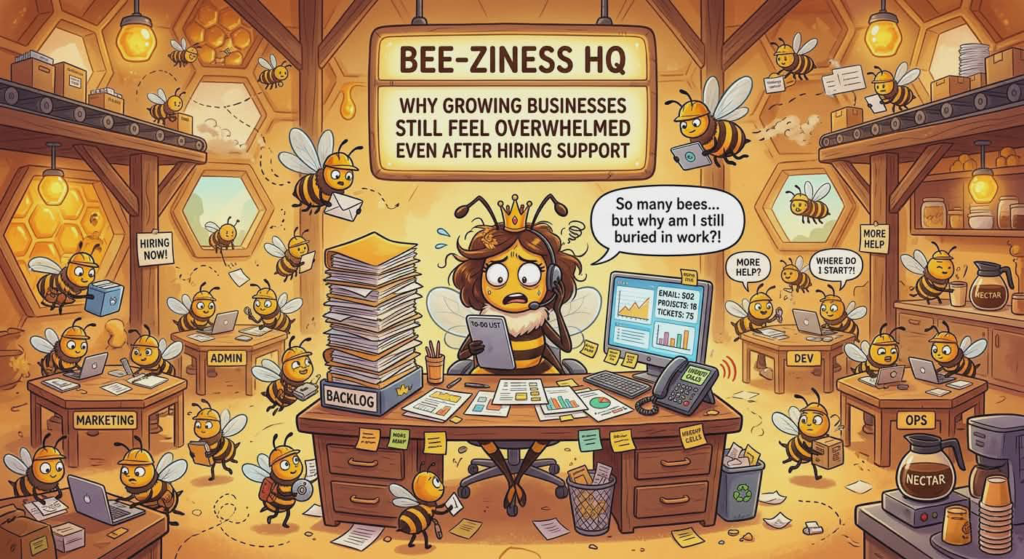
This is one of the biggest reasons growing businesses continue feeling overwhelmed — even after hiring support.
Because support alone does not automatically create operational clarity.
Why Hiring Support Does Not Always Reduce Workload
Many businesses assume hiring a virtual assistant or outsourced support will immediately create more time and reduce stress.
But in many cases, leadership still ends up:
- Constantly checking updates
- Repeating instructions
- Clarifying expectations
- Following up repeatedly
- Managing workflow confusion
- Correcting communication gaps
The business may technically have support, but leadership still carries most of the operational responsibility.
This usually happens because work has been delegated without creating structure around the work itself.
Without operational structure:
- Ownership becomes unclear
- Priorities constantly shift
- Communication becomes inconsistent
- Accountability becomes difficult to track
- Teams rely heavily on leadership direction
As businesses scale, these challenges become harder to manage informally.
For agencies and service-based businesses especially, this often affects:
- Client responsiveness
- Project turnaround times
- Team coordination
- Internal visibility
- Overall client experience
Delegation Without Structure Creates More Operational Friction
Many businesses think delegation simply means assigning tasks.
But sustainable delegation requires:
- Clear responsibilities
- Defined workflows
- Organized communication
- Accountability visibility
- Consistent processes
- Operational coordination
Without those systems in place, delegation can actually increase leadership involvement instead of reducing it.
This is especially common in growing businesses where:
- Processes only exist verbally
- Teams depend heavily on leadership decisions
- Workflows constantly change
- Internal coordination lacks consistency
- Follow-ups are handled manually
As operational complexity increases, businesses often begin feeling reactive instead of organized.
This is where operational integration becomes important.
Support works best when it becomes integrated into the workflow of the business — not operating separately from it.
Why Workflow Continuity Matters
One of the biggest operational challenges in growing businesses is inconsistency.
Tasks get delayed.
Projects stall.
Communication becomes fragmented.
Follow-ups are missed.
Teams wait for clarification.
Workflow continuity helps businesses create more consistency around how work moves across the organization.
This includes improving:
- Task coordination
- Communication flow
- Process visibility
- Responsibility tracking
- Team alignment
When workflows become more organized:
- Teams move faster
- Leadership follows up less
- Communication improves
- Operational bottlenecks become easier to identify
The goal is not to remove leadership from operations entirely.
The goal is to reduce unnecessary dependency on leadership for every small operational detail.
Communication Gaps Often Become Operational Problems
Many operational breakdowns are actually communication breakdowns.
Without clear communication systems:
- Teams receive incomplete information
- Expectations shift frequently
- Work gets duplicated
- Delays increase
- Leadership spends more time correcting misunderstandings
As agencies and service-based businesses grow, communication becomes more layered across:
- Clients
- Internal teams
- Projects
- Vendors
- Administrative workflows
Without operational alignment, communication gaps can quickly slow execution and create frustration across the business.
This is why organized communication systems become increasingly important as businesses scale.
Strong operational support should help communication feel more connected, visible, and coordinated across the business.
Why Accountability Visibility Is Important
One common operational challenge in growing businesses is invisible accountability.
When ownership is unclear:
- Tasks become harder to track
- Deadlines get delayed
- Leadership follows up repeatedly
- Bottlenecks become difficult to identify
- Teams become overly dependent on reminders
Operational visibility helps businesses better understand:
- Who owns what
- What is currently in progress
- Where delays are happening
- Which workflows need support
- What requires escalation
This creates stronger coordination and more consistent execution over time.
For growing businesses, accountability visibility becomes increasingly important as teams expand and workloads become more layered.
Why Leadership Capacity Matters
As businesses grow, leadership attention becomes one of the most limited resources inside the organization.
When leadership remains heavily involved in:
- Daily coordination
- Administrative oversight
- Constant follow-ups
- Workflow management
- Operational troubleshooting
It becomes harder to focus on:
- Business development
- Client relationships
- Strategic planning
- Growth opportunities
- Long-term initiatives
Over time, operational overload can limit a business’s ability to scale sustainably.
Strong operational support should help reduce operational friction so leadership can focus more effectively on growth-oriented responsibilities.
This is especially important for agencies and service-based businesses where leadership is often balancing:
- Client delivery
- Team management
- Revenue generation
- Business development
- Operations simultaneously
What Operational Support Can Include
Operational support may involve a combination of:
- Administrative assistance
- Executive assistant support
- Workflow coordination
- Customer support
- CRM management
- Scheduling and calendar management
- Internal communication support
- Reporting assistance
- Process documentation
- Social media coordination
- Digital and back-office support
But effective support is not only about completing tasks.
It is about helping work move more consistently and efficiently across the business.
As businesses grow, support systems become more valuable when they integrate into day-to-day operations instead of functioning as disconnected task support.
Why Operational Integration Matters for Growing Businesses
As businesses continue scaling, sustainable growth depends heavily on operational clarity.
Without operational integration:
- Leadership becomes overloaded
- Teams become reactive
- Workflows become inconsistent
- Communication becomes fragmented
- Client experience can suffer
Operational integration helps businesses create:
- More organized workflows
- Better coordination
- Clearer communication
- Improved accountability visibility
- More consistent execution
This creates stronger operational foundations that support long-term business growth.
For agencies and service-based businesses, operational integration also helps improve:
- Team collaboration
- Client responsiveness
- Workflow efficiency
- Operational consistency during growth periods
Final Thoughts
Growing businesses do not always need more manpower.
Often, they need:
- Better workflow organization
- Better communication systems
- Better operational visibility
- Better accountability structures
- Better coordination behind the scenes
Because sustainable growth is not only about increasing capacity.
It is also about improving how the business operates as complexity increases.
At WE R Solutions, we support agencies and service-based businesses through managed operational support systems designed to improve workflow consistency, communication alignment, and operational coordination as businesses grow.
Because strong support should not simply help businesses complete tasks.
It should help businesses operate more smoothly and sustainably.